

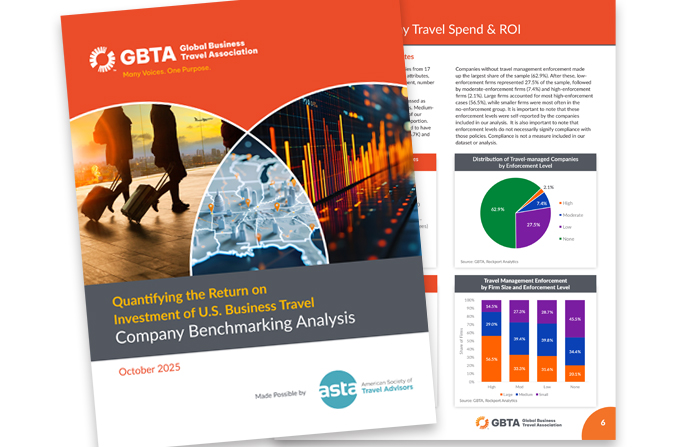
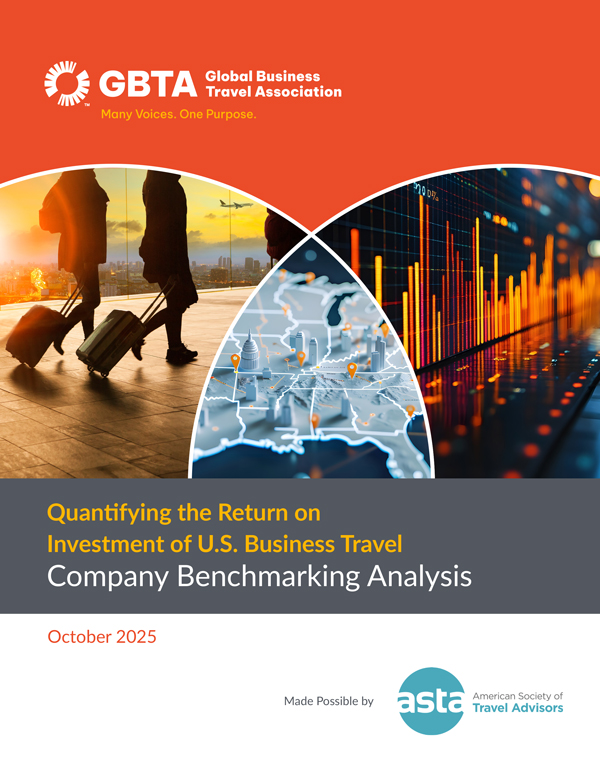
Chauffeured transportation operators don’t need a study to prove the value and impact of business travel on both your clients and the economy, but the Global Business Travel Association (GBTA) and American Society of Travel Advisors (ASTA) have done just that with a recently released report, Quantifying the Return on Investment of US Business Travel: Company Benchmarking Analysis.
Using data collected from more than 3,200 US firms across 17 industries, the study found “every 1% increase in managed travel spending is associated with a 0.20% rise in revenue, and firms that balance strategic travel policy controls and flexibility outperform firms that do not by up to 30%.”
The report is a follow-up to one released in July 2025 (also in conjunction with ASTA) that found that optimizing business travel could help companies collectively capture a whopping $2.4 trillion in new sales revenue—even with a modest increase of $184 per employee annually.
 GBTA CEO Suzanne Neufang
“Our partnership with ASTA on these ROI studies allows us to provide evidence-based insights into the strategic value of business travel and its impact on company performance—particularly for small and mid-sized organizations,” said GBTA CEO Suzanne Neufang in a press release about the report. “This latest company-level analysis is designed to empower travel managers and executives to optimize their business travel strategies, fuel growth, and maintain a competitive edge in today’s dynamic business environment.”
Key points of the report:
- A 1% increase in staffing corresponds to roughly a 1.1% rise in travel expenditures; each additional 1% in company locations adds about 0.08% to total spend.
- Capital-intensive sectors (e.g., energy, manufacturing) spend approximately 34% more on travel, while labor-intensive industries spend about 27% less.
- Companies with travel management programs spend a higher proportion of revenue on travel (0.76%) compared to the industry average (0.65%), reflecting higher travel intensity and more structured management.
Additional takeaways for our industry:
Focus on High-Spending Firms: Large firms have the biggest total T&E budgets, averaging $2.4 million, and tend to have structured travel programs. These firms often negotiate supplier rates and centralize booking, making them ideal clients for operators who can offer tailored services and competitive pricing.
Travel Management Enforcement: Companies with moderate or high travel management enforcement spend more on travel and achieve better business outcomes. Position (or reaffirm) yourself as a reliable partner that aligns with these structured travel policies, offering services that meet compliance requirements while ensuring efficiency, duty of care, and flexibility.
Targeting Smaller Firms: Don't just focus on the larger corporations. While smaller firms spend less overall, they typically face higher per-employee travel costs due to a lack of economies of scale, so offering cost-effective solutions can help these organizations optimize their travel budgets.
Strategic Partnerships: The study emphasizes the importance of travel as a key investment for growth-oriented firms of any size and industry. Highlight your company’s role in helping them enable client engagement, business development, and operational efficiency.
The full report is available here.
Visit gbta.org and asta.org for more information.
[12.02.25]

