


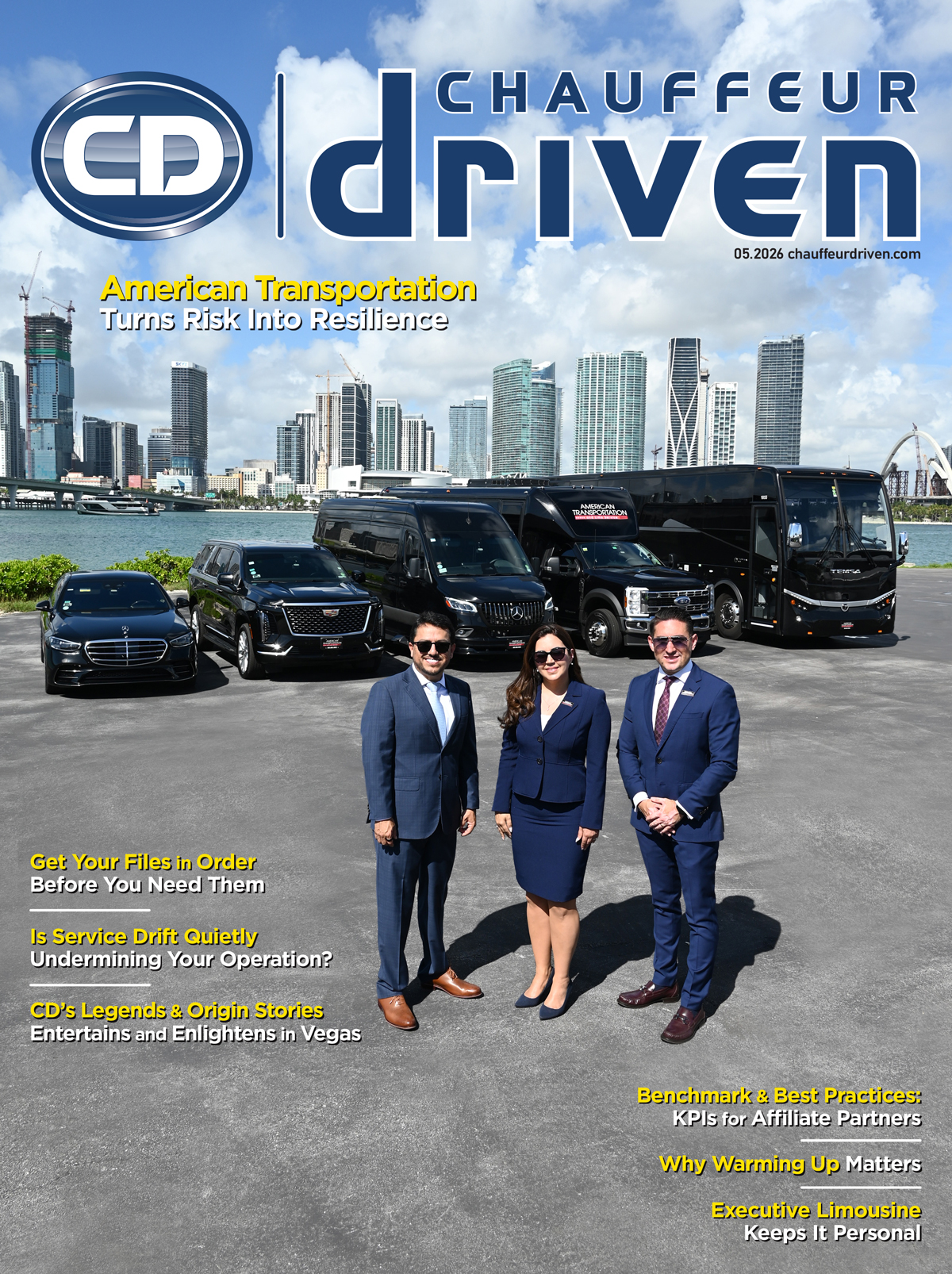
 Cover Art: L to R: American Transportation CEO Lenin Fraga, VP Yuri Velazquez, and General Manager Carlos Noboa overlooking the Miami skyline. Photography by Chris Weiss.
BY SUSAN ROSE
You either win or you learn.For entrepreneurs, it’s the culmination of risks, mistakes, and successes that often leads to the best results and strongest businesses. Learning to pivot when things aren’t tracking, staying the course against all odds, or picking themselves up when it ultimately doesn’t pan out are the hallmarks of those who are called to lead.
If the global financial system hadn’t buckled in 2008, taking hundreds of thousands of small businesses with it, there’s a very real chance that we wouldn’t know Lenin Fraga’s name, at least not in our industry. He would likely still be running his printing business—and American Transportation, as it exists today, would never have come to be.
“I had two clients who represented 85% of my business,” Fraga recalls of his printing company, which was successful for nearly a decade. “When they went bankrupt, I went bankrupt. It was across the board. Businesses were failing everywhere.” But in his case, concentration made it fatal.
For many small business owners, that would have been the end of a chapter—if not the end of entrepreneurship altogether. For Fraga, it became a blueprint for how he would build everything that followed. Adaptability, it turns out, has been his greatest asset.
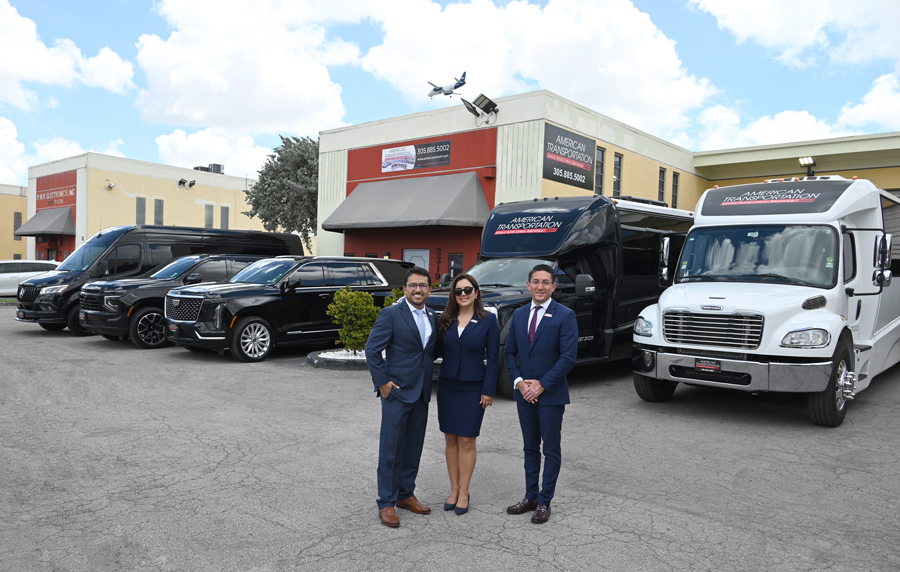 L to R: American Transportation CEO Lenin Fraga, wife and Vice President Yuri Velazquez, and General Manager Carlos Noboa at the company headquarters in Miami His journey to chauffeured transportation had already been anything but linear. Born in Ecuador, he arrived in the United States at 20 on a student visa, studying aviation mechanics—driven by practicality rather than passion as it was the only degree he could afford, he says. While attending school, he launched a small flower business in Miami Beach and Coconut Grove, an early sign that his instincts leaned toward building rather than following. That business eventually gave way to printing, a field deeply rooted in his family’s own financial security back in South America.
 But the collapse of 2008 didn’t just erase a business, it reset his trajectory entirely. Within months, Fraga found himself behind the wheel of a limousine in South Florida, out of necessity. He and his wife Yuri had two young daughters to feed after all, so what began as a stopgap quickly became something more. Seeing the potential, he purchased a single Cadillac Escalade in 2010, which became the foundation of American Transportation.
In the early days of American Transportation, Fraga did what most founders do: everything. He drove, cleaned vehicles, handled bookings, managed clients, and whatever else popped up. It was efficient at a small scale and completely unsustainable if he wanted to scale.
 L to R: Sales Agent Domenica Morales, Dispatcher Luis Noguez, Operations Agent Jesús Rodríguez, and Administrative Agent Iriana Pérez At that point, he was already looking for a growth trajectory and was starting to attend the trade shows and join industry groups like Wheels in Motion (later renamed Spinning Wheels, of which he is still a part), then led by Arthur Messina. That exposed him to a group of like-minded operators who were serious and curious like him, but who also had some sage advice to share.
 “I was told, ‘If you keep driving, you will never grow your business,’” Fraga says. “And that was very hard to accept. I loved driving. I really enjoyed it.”
But after six years of doing it all—along with his wife, who still handles accounting—he heeded the advice and hung up the keys. It was the moment he stopped being a chauffeur who owned a business and became a CEO who ran one.
“It triggered a lot of growth,” he says. “In the company and in myself.”
South Florida—particularly the Miami area—isn’t just another large metropolitan market; it’s a convergence point of international travel, seasonal wealth, entertainment, and cultural diversity that creates both opportunity and operational complexity. For transportation providers, demand is not only high, but also fragmented. Corporate travel surges in the winter months, tied to conventions, finance, and tourism, then drops sharply in the steamy and humid summer months, as much as 80%. Luckily, weddings, nightlife, concerts, leisure travel, schools, and other types of retail work continue year-round, often peaking when corporate slows. This type of approach has helped immensely with seasonal volatility.
“You can’t rely on one segment here,” Fraga explains. “Corporate is strong, but it disappears in the summer.” That seasonality forces operators to think differently because diversification isn’t just a growth strategy in Miami—it’s survival.
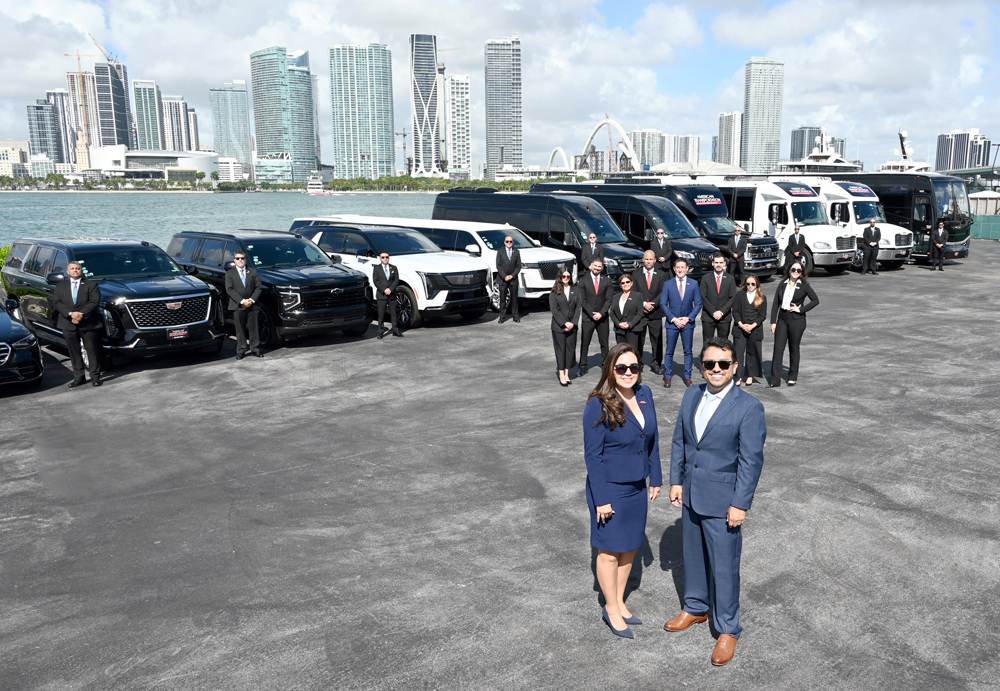 Velazquez and Fraga their team and fleet overlooking the Miami skyline The clientele itself is equally complex. South Florida draws passengers from across the United States and the world but the city and even the region is very different from other metropolitan areas. It’s a blend of Latin American and Caribbean culture, with a sprinkling of US transplants from four-season climates looking to escape the snow or higher taxes. Not only is Miami predominantly Hispanic—and Spanish speaking—but more than 50% of those residents are foreign-born themselves. While this is a benefit for their Spanish-speaking clients, it’s often a struggle for travelers who aren’t versed in the language.
 “About 85% of our clients are English-speaking,” Fraga says, which creates a unique hiring challenge when their local talent pool is often Spanish-first or -only. “We go through 50 applicants to maybe find five,” he says.
It’s within this environment that American Transportation has taken shape. Today, the company operates a fleet of roughly 40 vehicles, supported by close to 50 chauffeurs and a hybrid remote workforce that spans continents. About 14 office staff are based in the States, with another 10 working from abroad. Fraga has intentionally built much of that talent pipeline from his home country of Ecuador, where he frequently travels with his family and remains closely connected to the community. Many of the company’s chauffeurs, operational staff, and support team members are Ecuadorian—something Fraga takes particular pride in.
For him, the company’s growth has become more than just building a transportation business; it has also created opportunities for people from his own community to access stable, professional careers with stronger earning potential and long-term growth. Through referrals and word of mouth, candidates continue reaching out organically. “They bring me more people” he says about his remote workers based in Ecuador. “And I make sure they speak good English.”
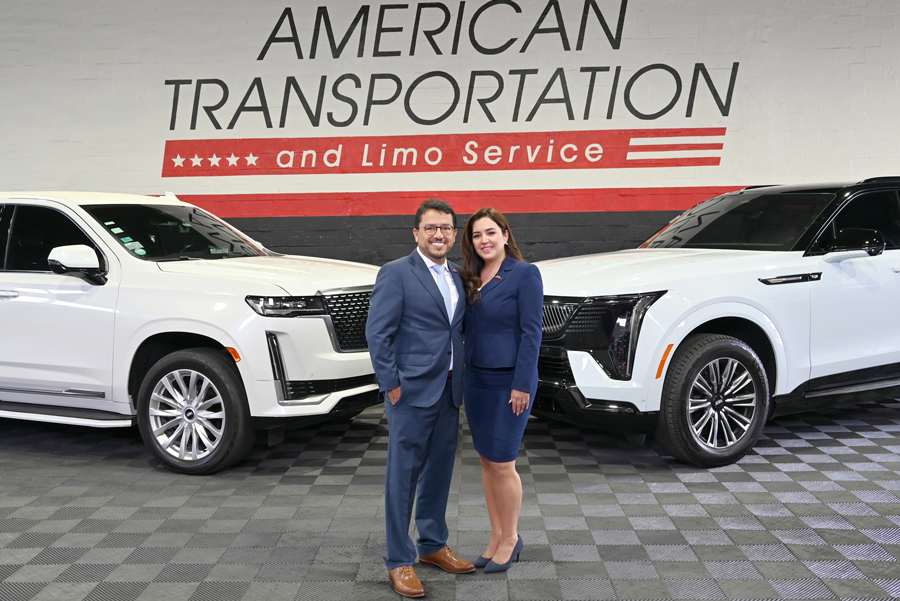 Fraga and Velazquez That attention to detail carries through every layer of the operation, because above all else, service quality is non-negotiable. That guiding principle is why Fraga has tempered aggressive growth, especially regarding his fleet, because he never wants it to come at the expense of service quality. That restraint is another mark of a seasoned entrepreneur who has seen both sides of growth, from the upside to the fragility. Bigger isn’t automatically better if it introduces risk you can’t manage.
 “We can lose money, but if we lose reputation, we’ve lost a lot,” he says, not only about his team, but how he and his senior staff comport themselves. “Everything that we do is very important. The way that I act at industry events reflects on my company, so I’m very careful about that.”
American Transportation has amassed more than 1,400 five-star reviews, a figure Fraga points to as a primary differentiator in a crowded market. But the reputation he’s protecting extends far beyond online ratings.
Likewise, affiliate work is treated with an almost heightened level of care. “Sometimes we put more attention into affiliates than our own clients,” he says. “Because they are trusting us with their VIPs.”
That sensitivity to risk—particularly reputational risk—can be traced directly back to 2008. If there’s a single lesson that shaped American Transportation, and probably countless other operations in our space, it’s diversification. He’s careful to ensure that no single client accounts for more than about 7% of the company’s revenue, he says.
 L to R: Velazquez, daughter Manuela, mother Sheyla Esthela Mendoza, daughter Briana, and Fraga
 That same opportunistic mindset carried the company through the pandemic. When traditional demand evaporated, Fraga pivoted quickly into yacht charters. After all, people were still flocking to the sunshine of Florida in 2020 and 2021, despite travel limitations and restrictions.
“I saw all these boats on the water,” he recalls. “And I realized there was demand.” Within months, he had acquired multiple yachts, running several charters a day at the peak. At the same time, party bus demand surged, so he added seven more to his fleet, capitalizing on demand for contained, private group experiences when venues were closed. When tastes changed again a few years later, he met the moment and shifted. It worked—but more importantly, he knew when to exit.
“We can all fall, and we all come from different backgrounds. But I believe if you work hard and you put ideas into actions, you can come back from any defeat or difficult position.” – Lenin Fraga, CEO of American TransportationIf agility defines his strategy, control defines his operations. He invests heavily in training and oversight, and he prefers to hire staff chauffeurs rather than work with independent operators (although he uses a handful of trusted partners). New chauffeurs go through structured onboarding, followed by hands-on training tailored to the company’s standards and near-daily team meetings. Technology plays a significant role as well. As an early adopter of automated texting, call recording, and now AI-driven call analysis, he identifies areas that need improvement regularly.
Importantly, he sees AI as a training tool rather than a replacement. “We’re not using AI to answer calls,” he explains. “We’re using it to coach our people, improve accountability, and continuously raise service standards.” That distinction reflects his broader philosophy: technology should enhance human service, not replace it.
At the core of that identity is a service-oriented mindset, which he calls his servant heart. It’s a phrase he returns to when describing both his approach to clients and his relationship with employees. He speaks of his team as family, not as a cliche, but as a lived dynamic. Several of his own family members are involved in the business, including his wife, sister, cousins, and even his mother, helping create a close-knit culture that extends throughout the organization.
Right by his side is his wife who, besides handling billing, can be a Jill-of-all-trades, whether it’s washing vehicles or helping build out their workspace. At the same time, his general manager, Carlos Noboa, is a critical operational counterpart, who Fraga calls incredibly smart, hardworking, and loyal.
“I’m closer to my team than to anyone else,” he says. “They are the ones in the trenches with me. Treat your people right. Pay them well and care about them.”
That culture has translated into loyalty and stability, even in an industry known for turnover. Many of his chauffeurs have stayed for years, and even those who have unfortunately left—sometimes for more lucrative private driving positions—maintain relationships with the company.
Looking ahead, Fraga sees growth in larger equipment and expanded geographic reach within Florida. With plans to add motorcoaches and establish a presence in additional cities throughout the state, the company is positioned to evolve further. But the guiding principles are unlikely to change.
At the end of the day, Fraga doesn’t frame his story around where he started or even where he is now. Instead, he focuses on the mindset that carried him through both. The company he started out of necessity for his daughters—Briana, 24, and Manuela, 20—helped sustain his family through one of the roughest recessions of our lifetime, and now they’re building lives of their own.
“We can all fall, and we all come from different backgrounds. But I believe if you work hard and you put ideas into actions, you can come back from any defeat or difficult position,” he says. “I’ve always been an entrepreneur, so if this venture ever fails, I’ll just start again. I’m not afraid to risk but definitely learn from your mistakes and treat your people right.” [CD0126]

