

BY SUSAN ROSE
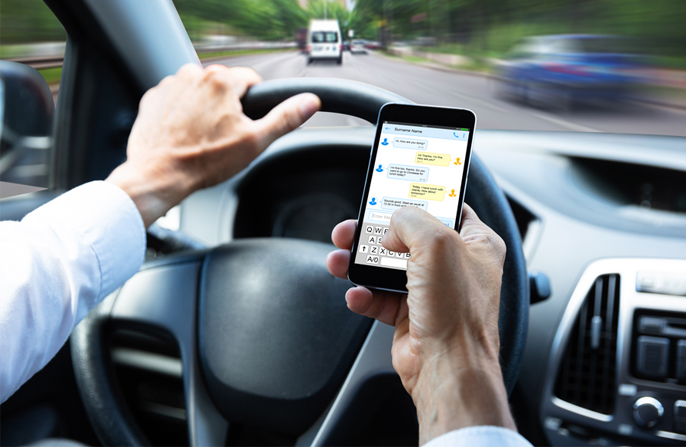
Editor’s note: If you’re looking for a good companion piece to this top, turn to page 32 where Tom Holden addresses the physical demands of chauffeuring.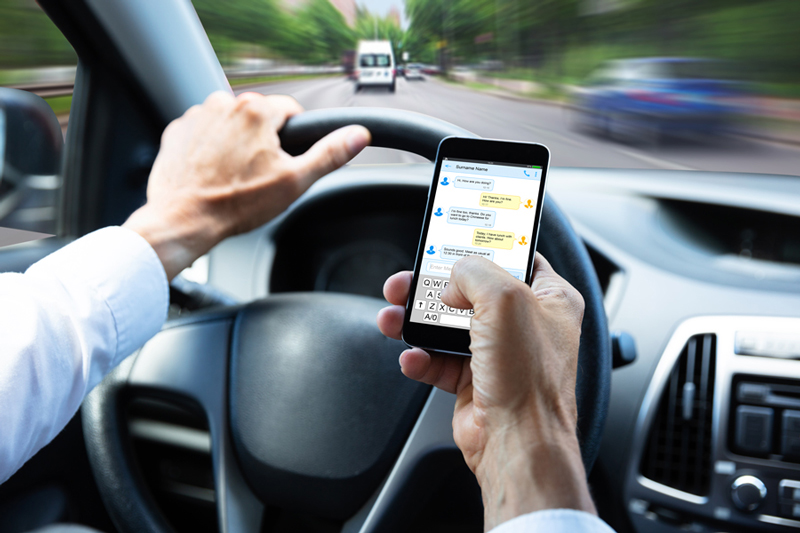 For chauffeured transportation operators, safety is not just a value, it is the foundation of the business. Your clients entrust their lives to your professionally trained chauffeurs every day. With so many moving parts and logistics to deal with in this business, your chauffeurs are asked to multitask at a level that could challenge anyone—from communicating with dispatch, monitoring potential traffic or weather, operating the vehicle in a smooth and calm manner, and being reactive to the other drivers around them who may not be paying full attention themselves. Add to that a Sprinter full of rowdy passengers pushing their music ever louder and it’s a lot to take in while concentrating on the road. However, one risk has quietly grown into one of the most significant threats facing fleets today: distracted driving, particularly phone use behind the wheel.
 At the CD/NLA Show in Dallas last October, cognitive scientist Dr. Paul Atchley of the University of South Florida delivered a research-driven presentation that challenged many long-held assumptions about driver behavior, training, and technology. His message was clear and uncomfortable: using a phone while driving is as dangerous as driving drunk—sometimes more so—and education alone will not fix the problem.
For an industry that employs chauffeurs, the implications are profound. Distracted driving is not simply a personal choice made by individual drivers, but a systemic risk shaped by company culture, policies, expectations, and enforcement. Understanding why it happens—and what actually works to stop it—is essential for protecting lives, reducing crashes, limiting liability, and sustaining a professional operation.
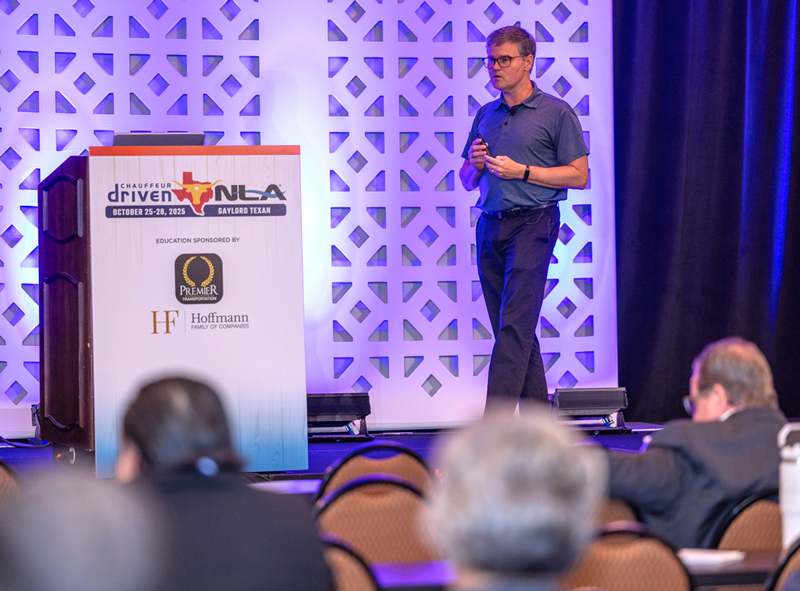 Dr. Paul Atchley at October’s CD/NLA Show “This Is a Very American Problem”
Our industry tends to drive vehicles that are tech-heavy with the latest safety protections, which can go a long way to avoid crashes or obstacles. It’s a fact that modern vehicles, roads, and emergency response systems are dramatically safer than those of previous generations.
“Think about all of the safety improvements we’ve had—stability control, automatic braking, better roadways, faster emergency response. All of this would predict that crash rates should be plummeting,” Atchley said during the session.
And for a time, they were. Then smartphones arrived.
“When smartphones came out, we started to see a plateau in safety. And when smartphones became heavily adopted, we started to see crash rates and fatality rates go up,” he said.
The pandemic provided especially stark evidence. Despite fewer miles driven in 2020 and 2021, US traffic fatalities surged to the largest increase in almost 100 years. In fact, when compared to Europe, which fell by 13% during the same period, the US had a 24% increase in fatalities.
As Atchley said: “This is a very American problem.”
What Is Distracted Driving—and Why Phone Use Is Different
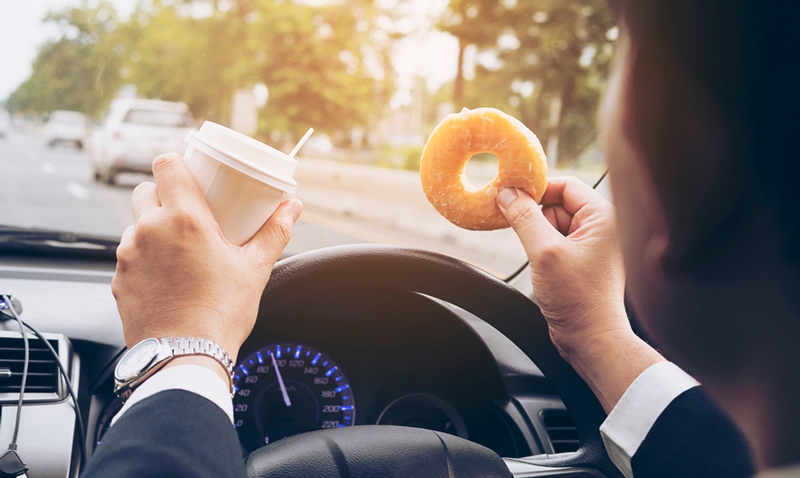
Distracted driving includes any activity that diverts attention away from the primary task of driving. This can involve eating, adjusting controls, interacting with passengers, or even daydreaming. However, decades of research now show that phone use—whether handheld or hands-free—is in a category of its own.
 Atchley highlighted multiple large-scale studies published in journals such as the British Medical Journal and the New England Journal of Medicine that found that using a phone while driving increases crash risk by more than 400%. That level of risk mirrors, and in some cases exceeds, the danger posed by drunk driving.
 One of the most striking findings emphasized by Atchley comes from simulator studies led by researcher Dr. Dave Strayer of the University of Utah. In these experiments, sober drivers using phones crashed four times more often than intoxicated drivers who were not distracted. The reason is not slower reflexes or poor motor control; it is something far more insidious: cognitive distraction.
The Cognitive Reality: Why the Brain Cannot Multitask
We like to think of ourselves as superhuman when it comes to multitasking, but reality paints a different picture. Despite widespread belief to the contrary, the human brain cannot multitask. Instead, it rapidly switches attention between tasks, degrading performance in both. Driving is already one of the most cognitively demanding activities most people perform (consider how you feel after a long drive with multiple people in your vehicle). Adding a phone conversation—especially one involving decision-making, emotional content, or time pressure—pushes the brain beyond its limits.
And before you think that a hands-free system is the solution, the facts say otherwise. That’s because distraction is not in the hands—it is in the mind. A chauffeur engaged in a dispatch call or other conversation may be looking at the road, but their brain is no longer fully processing it.
Atchley presented research that shows that:
❱ Cognitive distraction reduces visual processing activity in the brain by up to 40%.
❱ Drivers on phones experience “inattention blindness,” failing to see hazards directly in front of them.
❱ Hands-free conversations shrink a driver’s scanning field or field of vision, causing them to miss pedestrians, cyclists, or sudden vehicle movements.
❱ Drivers using phones cognitively function like elderly adults with dementia, with up to a sevenfold increase in crash risk.
The Scale of the Problem: Data from Real-World Fleets
While simulator studies are compelling, real-world fleet data confirms the severity of distracted driving. Telematics analyses covering millions of miles and tens of thousands of crashes worldwide reveal a consistent pattern: phone use is the single most dangerous driver behavior.
One major analysis found that:
❱ Phones were involved in 25% of crashes in the minute before impact.
❱ 17% of crashes involved phone use in the final five seconds before impact.
These are not minor fender-benders: they include serious and fatal collisions. For chauffeured transportation operators, where vehicles are larger, heavier, and carrying passengers, the stakes are even higher.
Why Education Alone Fails
Many operators respond to distracted driving concerns by increasing training, holding safety meetings, or distributing educational materials. While education is important and absolutely essential, research overwhelmingly shows that education alone does not change driver behavior.
Chauffeurs already know that distracted driving is dangerous. The problem is not lack of information, it is cognitive bias and behavioral conditioning.
A study found that drivers:
❱ Underestimate their own risk, believing crashes happen to “other people”
❱ Overestimate their ability to safely handle calls or texts
❱ Believe they are “good multitaskers,” despite evidence to the contrary
❱ Feel pressure—real or perceived—from the office to stay constantly available
The “Cookie Jar” Effect: Policies Without Enforcement
Many companies technically prohibit phone use while driving, but fail to enforce those rules consistently. Atchley describes this as the “cookie jar” effect: When people know that rules exist but consequences are unlikely, violations actually increase.
Fleet data confirms this:
❱ Companies with phone bans but no monitoring or enforcement often see higher crash rates.
❱ Companies that combine clear bans, monitoring, and real consequences reduce crashes by 30% to over 70%.
Atchley likened this to the lessons learned from public health efforts like tobacco control. Education raised awareness, but meaningful behavior change only occurred when smoking became inconvenient, costly, and socially unacceptable.
What Actually Works
So, while all of this is sobering and possibly even depressing, this data presents a smarter way for operators to train and change chauffeur behaviors. The most successful operators take a systems-based approach to distracted driving, recognizing that human limitations require environmental and organizational solutions. Ambiguous rules create loopholes and lead to rationalization for said behavior.
1. Clear, Absolute Phone Policies
The most effective policies are simple and uncompromising:
❱ No phone use while driving—handheld or hands-free—which we understand might be controversial
❱ No texting, emailing, browsing, or social media
❱ Limited, clearly defined exceptions only when safely parked
2. Monitoring and Telematics
Modern telematics systems, already used by many operators, can detect:
❱ Phone movement and screen interaction
❱ Hard braking, acceleration, and cornering
❱ Patterns that indicate distraction
This monitoring shouldn’t be about punishment—it is about visibility and accountability. Correcting behavior should be a constructive exercise, not a gotcha moment for managers. Drivers behave differently when they know behavior is monitored fairly and consistently for everyone’s benefit.
3. Coaching, Consequences, and Removal From Driving
Effective programs include:
❱ Coaching for first violations
❱ Escalating consequences for repeat offenses
❱ Removal from the schedule/suspended when behavior does not change
This is not about being harsh—it is about protecting clients, other motorists, the business, and even the chauffeur. Allowing a chronically distracted driver to remain behind the wheel exposes operators to enormous moral and legal risk, not to mention potential lawsuits in a highly litigious time.
While Atchley’s presentation was specific to cellphones, it’s worth noting that clear and signed policy agreements regarding clients’ behaviors before the trip takes place is a worthy endeavor. After all, the ride should be enjoyable for the clients, but the chauffeur’s primary task is and always will be safe driving.
Building a Culture of Safety
Cultural change does not happen overnight. Initial resistance is normal. However, Atchley noted that companies that commit to strict distracted driving policies report that within about a year. Chauffeurs often become advocates for phone-free driving. Large organizations such as Amazon and FedEx have implemented cameras, monitoring, and strict enforcement without harming operational performance. The keys to compliance are leadership commitment, fairness, and consistency.
Operators play a crucial role in adoption of these policies by modeling compliance themselves (you know who you are!), communicating why policies exist, and supporting chauffeurs when dispatch or a fleet supervisor pushes for immediate responses while driving. Instead, encourage the chauffeur to respond only when it’s safe and to use tools like navigation before the vehicle is moving. While this seems like common sense, it’s surprising how often it’s not followed.
The Limits of Training—and the Need for Structural Change
No amount of training can overcome human cognitive limits. Even fighter pilots cannot reliably manage more than a handful of tasks at once. Attempts to train drivers to “handle” phone conversations while driving have consistently failed.
Meaningful change requires making phone use difficult while driving, having a mechanism for detecting violations, and most importantly, sticking to real consequences. Again, while Atchley’s suggestions can be controversial, companies in our sector can benefit from training their chauffeurs to use “do not disturb while driving” modes or physically placing phones out of reach or view—but organizational support is essential.
Leadership Responsibility in a High-Risk Environment
Distracted driving is not a minor operational issue. It is one of the most significant safety, liability, and reputational risks facing chauffeured transportation operators today. And for an industry that is facing ever-higher insurance rates, trust us—the insurance companies are watching your safety culture and record.
The research presented by Atchley makes one thing unmistakably clear: Phone use while driving is a lethal combination, and good intentions are not enough to stop it.
Wrapping it up, the path forward is challenging but clear:
❱ Acknowledge the cognitive reality
❱ Move beyond education alone
❱ Implement strict, enforceable policies
❱ Support drivers structurally, not just verbally
❱ Lead cultural change from the top
In an industry built on professionalism, trust, and safety, addressing distracted driving decisively is not just good practice, it is a non-negotiable responsibility. For a sampling of Atchley’s presentation, the following link is from his TED Talk a bunch of years ago exploring many of the same themes he addressed in his session at the CD/NLA Show. The link: http://bit.ly/3ZqM3iE. [CD0226]

