


BY SUSAN ROSE
Chauffeured transportation has always been about more than just the luxury black car; it’s about the full experience, from the booking to the chauffeur to the final safe delivery. And while most (hopefully all!) operators train their team upon hire, too many take for granted that the lessons stuck or don’t erode over time. It’s a muscle, but it can atrophy. I don’t need to tell you that customer service has become somewhat of a lost art. As service professionals yourselves, you already see it when you go to everyday retail establishments, where the tip jars or screens are usually more plentiful than thank yous and accurate orders. So when you do receive the expected service and everything just works, it almost feels exceptional in comparison—and typically makes you want to return. There’s a reason why companies like Chick-fil-A still have drive-thru lines circling the building while Starbucks has been attempting to claw its way back to sugary-sweet coffee dominance.
 “...Operators need to double down on what makes their service necessarily different, because no matter how much you slap “Uber for Business” on the invoice, it’s still lightyears away from what a professionally trained chauffeur can and should deliver.”The customer service crisis is exactly what James Blain of PAX Training addressed in his recent session at March’s CD/NLA Show in Vegas called The Secret Formula for Passenger Loyalty & Growth. If there was a single theme that defined Blain’s session, it’s that the chauffeured transportation industry is no longer competing in a vacuum. It’s operating in a broader service economy that he too sees is actively deteriorating.
Consider that, according to data Blain highlighted from Forrester Research, survey respondents claim that customer service across the business community has been dropping for at least the past three years. Customers cite long waits, inconsistent service, and having to repeat themselves across industries. Worst of all, Forrester Research says that fewer than 1 in 20 companies consistently put the customer first in how they operate. That’s unthinkable, especially in a service industry.
For operators, that reality creates a complicated dynamic. On one hand, expectations are dropping across the board; on the other, customer frustration is rising. As Blain put it, many of today’s passengers are arriving with chips on their shoulders before the trip even begins because they expect to be let down.
That tension, however, is exactly where opportunity lives—if companies can remain resolute and continue to execute at a high level.
Blain challenged attendees to rethink how they view competition, particularly when it comes to TNCs. For years, operators have framed their value proposition around being “better than Uber,” but Blain argued that this mindset is fundamentally flawed. “The only way you win against rideshare is to not compete against rideshare,” he said.
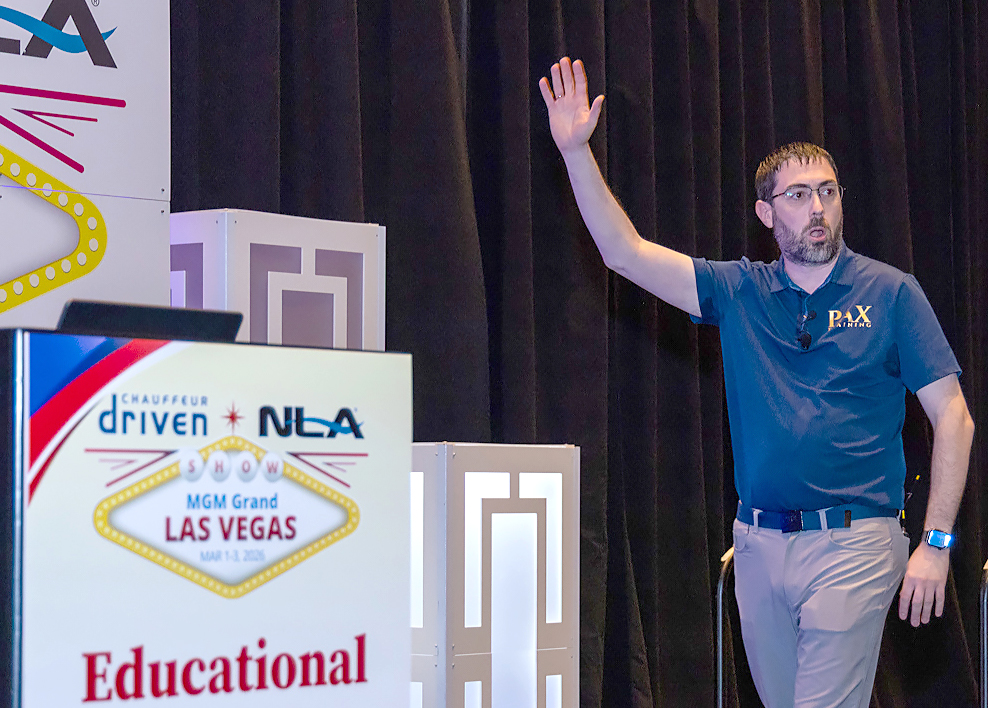 Companies like Uber dominate in convenience, scale, and price, and trying to beat them on those terms is a losing battle—even when they are doing more every day to encroach into our space. Instead, operators need to double down on what makes their service necessarily different, because no matter how much you slap “Uber for Business” on the invoice, it’s still lightyears away from what a professionally trained chauffeur can and should deliver. Why be Ramada Inn when you’re selling the Four Seasons?
 “Growth is a systems game, and most companies are playing checkers by focusing on putting out daily fires. The only thing that grows for the sake of growth is the cancer cell.” – James Blain of PAX Training ”“You have something they don’t: You have service. You have chauffeurs that care. You have dependable, reliable service,” he said.
So, what should operators actually be selling? According to Blain, it’s not the vehicle, and it’s not even the ride itself—it’s the outcome. It’s peace of mind.
That idea runs deeper than marketing language; it’s about creating an experience where the client never has to worry about whether things will go right. Safety, reliability, professionalism, and communication all feed into that sense of confidence. This becomes even more important as new technologies like AVs continue to evolve.
“Chauffeuring is going to matter more in the next five to 10 years than it has in the last 20,” he said, pointing out that technology may replace convenience-based trips, but it cannot replicate human service at the highest level.
At the heart of Blain’s message was a deceptively simple concept: consistency. In an industry where operators pride themselves on delivering great experiences, the real challenge is delivering the same experience every time. You know that customers don’t just evaluate you based on your best day—they judge you based on what they can expect every time they book. Inconsistency—whether it’s in chauffeur behavior, vehicle amenities, or communication—creates doubt, and doubt erodes trust. Without trust, loyalty doesn’t stand a chance, and it’s not a one-and-done kind of thing.
Your Operation Is Only as Strong as These Three Roles
1. Customer Service Representative (CSR): CSRs are often the first point of contact, yet many fail to create value. Instead of engaging the client, they default to transactional responses. CSRs should guide the conversation, ask questions, and uncover the full scope of the client’s needs naturally during the interaction.
2. Dispatcher: If CSRs are sales, dispatch is operations control. Great dispatchers don’t just react—they anticipate. They monitor trips, identify issues early, and adjust before problems escalate. Consider them the wingman for your chauffeurs, a dynamic duo for a successful trip.
3. Chauffeur: These folks are your most obvious and important touchpoint that represents your brand. If they don’t knock it out of the park every time, there’s no reason for the customer to stay. Honorable mention: Timely billing and post-ride follow-up are as critical as the ride. Same day is best. Don’t drop the ball at the finish line.
The Details That Define the Experience
Blain emphasized that service excellence isn’t about one moment—it’s about executing every step of the journey. Ironically, most service failures happen when the fundamentals you take for granted are missed, not the complex details that were triple-checked. It’s overlooking the water in the back of the car or the way they greeted the client. Clients can’t build or maintain an emotional connection with you if they can’t trust you to get it right.
Bottom line: It comes down to training and retraining because complacency breeds inconsistency. And when things go wrong, own it and learn from it. Believe it or not, a mistake can actually strengthen the client relationship if handled honestly and properly.
Training Isn’t Optional—It’s Everything
As you would expect from the president of a training company, Blain was unequivocal: It matters. Again, customer service is a muscle that needs to be worked to stay strong, and best operations use structured, repeatable systems frequently that are hands-on and documented. This isn’t just about service—it’s also about risk management. As insurance markets tighten, documented training and policies are becoming critical.
Build Systems Before You Grow
“Growth is a systems game, and most companies are playing checkers by focusing on putting out daily fires. The only thing that grows for the sake of growth is the cancer cell. If you’re just growing to grow, if you have no plan, if you’re going to figure it out as you go along, the problems are going to grow with you. If you’re not playing ahead, you’re playing from behind,” he said. Instead, operators should think strategically. What this means is having clear policies, consistent training, measurable performance, and, most of all, accountability.
The Bottom Line
In a world where service is declining and competition is increasing, the winners won’t be the cheapest or the biggest—they’ll be the most consistent. For operators willing to focus on the fundamentals, build systems, and deliver consistently (or reaffirm their commitment to those basics), that feeling becomes the ultimate competitive advantage. And in today’s market, that’s what turns rides into loyalty. [CD0526]
